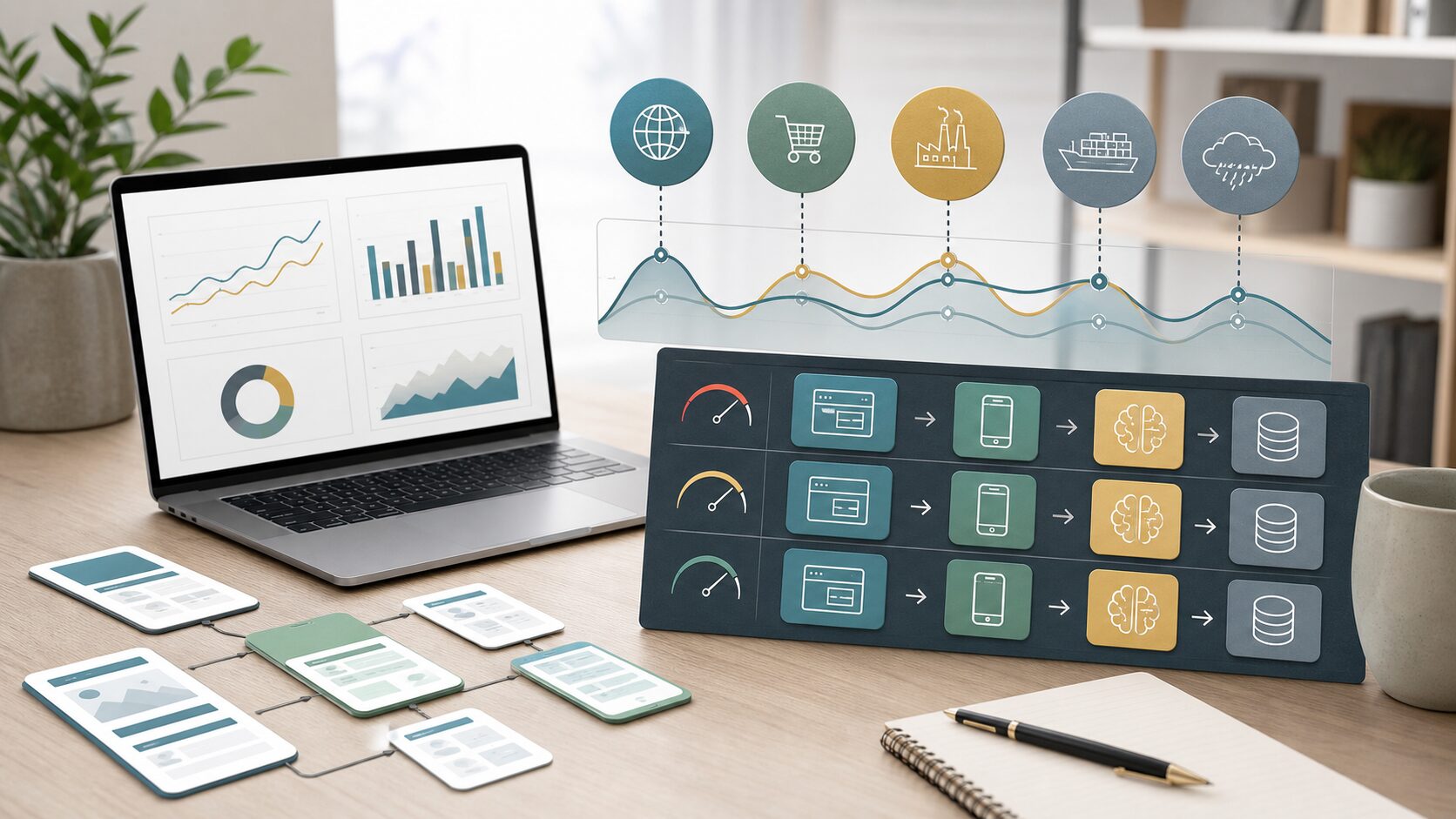
Economic news is not only for investors. For companies planning websites, apps, business systems, and AI-enabled workflows, it can affect development budgets, sales plans, hiring, advertising, pricing, and overseas transactions. The RSS items collected for the June 9, 2026 22:00 slot included broad economic topics: the U.S. trade balance, Canadian international merchandise trade, Mexico CPI, a schedule item around Japan domestic corporate goods prices, reporting on possible Bank of Japan rate moves, China economic concerns, and a meeting involving Japan’s economy minister and Malaysia’s investment, trade, and industry minister.
The collected context is mostly headline and summary level. It is not enough to state indicator values, policy certainty, or detailed company-specific effects. This article therefore does not turn current headlines into forecasts. Instead, it explains how business and technology teams can translate economic signals into practical priorities for digital operations. It is not investment advice.
Read economic news as a checklist of assumptions, not as a prediction engine
When reading economic news, the first question is not how dramatic the headline sounds. The useful question is which business assumption might need to be checked. Trade and foreign-exchange-related news can affect imported goods, overseas contractors, cloud spending, cross-border commerce, and billing currencies. Inflation and interest-rate news can affect advertising budgets, hiring costs, financing, consumer purchasing power, and long-term system investment. Policy and international-meeting news can become prompts to review subsidies, regulation, industrial support, and overseas expansion plans.
A single headline should not automatically change the plan. Economic indicators depend on timing, country, month-on-month or year-on-year framing, seasonal adjustment, and the gap between actual results and expectations. In operations, the stronger approach is to decide which assumptions need confirmation.
| News type | Assumption to check | Digital action |
|---|---|---|
| Trade and FX | Overseas procurement, contractors, cloud costs, cross-border sales | Review price display, billing currency, contract renewals, inventory, and delivery information |
| Prices and rates | Customer purchasing power, advertising cost, borrowing cost, long-term investment | Prioritize conversion improvements, LTV management, and low-return feature review |
| Regional economy and tourism | Local demand, visitors, hiring, surrounding industries | Improve local SEO, multilingual pages, reservation flows, and inquiry flows |
| Policy and international meetings | Subsidies, regulation, industry support, overseas expansion | Check application requirements, data handling, translation, and local landing pages |
| China and overseas demand | Supply chain, sales destinations, price competition | Prepare alternative procurement, lead-time visibility, inventory integration, and B2B materials |
Five decision axes for web, app, and AI investment
1. Improve flows closest to revenue first
When economic uncertainty is high, improvements close to revenue are often easier to measure than flashy new features. Check inquiry forms, brochure requests, reservations, estimates, payments, post-login retention, and other points where users hesitate. Before increasing ad spend, confirm that existing traffic is not being lost.
2. Reflect price and cost changes in both screens and operations
Changes in currency, materials, logistics, and cloud costs affect more than price tables. They also touch FAQs, terms, renewal emails, and internal cost controls. In B2B and ecommerce settings, unclear price-change timing or customer treatment increases support workload. Development teams should check whether pricing can be updated through a CMS or admin screen without code changes.
3. Do not evaluate AI adoption only as labor-cost reduction
In difficult economic periods, generative AI and automation are often framed as cost-cutting tools. But AI adoption also requires prompt design, review rules, log management, security, copyright checks, personal-data handling, and internal governance. A practical first step is to start with tasks that humans can verify, such as draft writing, FAQ classification, inquiry summaries, sales-document outlines, and code-review assistance.
4. Connect overseas news to multilingual readiness and risk controls
International trade and overseas economic headlines are not enough to justify immediate expansion. They are useful prompts to inspect multilingual pages, terms, privacy policy, inquiry handling, payment, currency display, and support coverage. English and Spanish pages should be more than direct translations; they should include appropriate terminology, price display, and contact flows for the target users.
5. Manage with scenarios, not single forecasts
Rates, prices, currency, and overseas demand can shift quickly. Instead of relying on one forecast, prepare a base scenario, cautious scenario, and growth scenario. Decide in advance which conditions would change advertising, hiring, development, inventory, or outsourcing. Dashboards become more useful when they include cost per inquiry, close rate, churn, inventory turnover, and lead time, not only page views and revenue.
A 30-day operating plan
- Week 1: Choose three economic signals relevant to the business, such as FX, prices, interest rates, overseas demand, or regional demand.
- Week 2: Map each signal to affected web pages, admin screens, ads, contracts, and support workflows.
- Week 3: Improve the easiest high-impact items: pricing notes, lead times, FAQ, forms, conversion paths, and report fields.
- Week 4: Review changes in sales, inquiries, ad cost, churn, and support topics, then reflect the findings in the next month’s priorities.
This process does not require reading every economic headline. The point is to translate headlines into business assumptions, separate information that should be updated from judgments that should be held, and build digital operations that tolerate change.
Questions buyers should ask development partners
- When the economic environment changes, where can pricing, delivery time, and campaign information be updated?
- Do multilingual or overseas-facing pages consider inquiry flows and legal checks, not only translation?
- If AI is used, are prohibited inputs, reviewers, and log retention rules defined?
- When advertising or development budgets change, are there KPIs that support prioritization?
- Can monthly reporting connect economic signals with site and product metrics?
FAQ
Can economic news tell us the correct development investment?
No. Economic news is one input. It must be read together with revenue structure, customer segments, cash flow, operating capacity, and existing system constraints.
Should new development stop during uncertain economic periods?
Not automatically. Revenue-adjacent improvements, operational cost reductions, security work, and legal compliance may become riskier if delayed. The priority order should be reviewed rather than frozen.
Should AI adoption be rushed when the economy is difficult?
Rushing can increase verification and information-management risk. Start with small workflows that humans can check, then measure quality, time saved, and inquiry reduction.
RSS sources used
- U.S. economic indicator: trade balance – Minkabu
- Canada economic indicator: international merchandise trade – Minkabu
- Mexico economic indicator: CPI – Minkabu FX
- Tomorrow’s economic schedule including domestic corporate goods prices – Yahoo! Finance Japan
- Reporting on possible Bank of Japan rate action – Mainichi Shimbun
- Article on China’s economic slowdown – Diamond Online
- Japan economy minister’s meeting with Malaysia’s investment, trade, and industry minister – METI